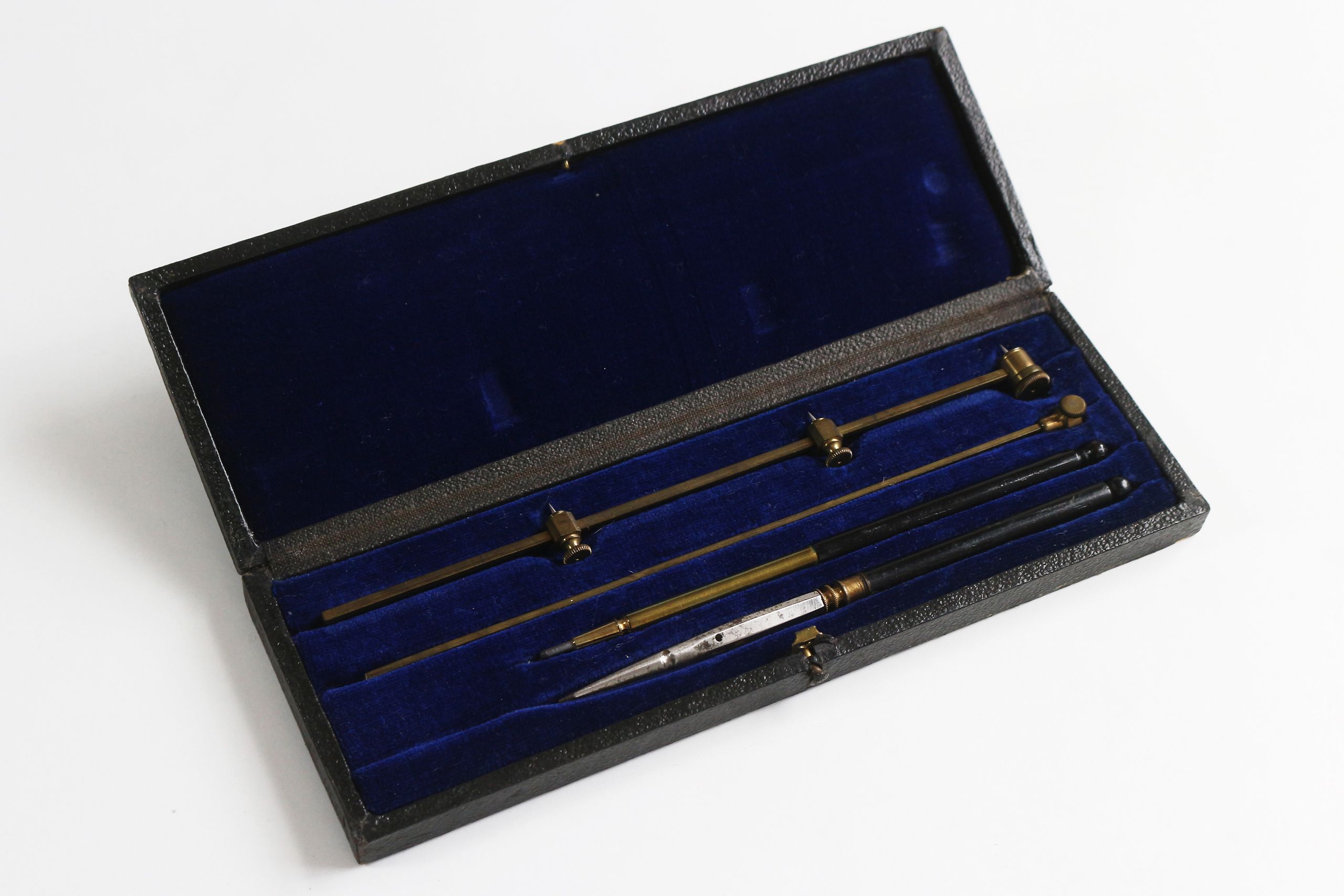
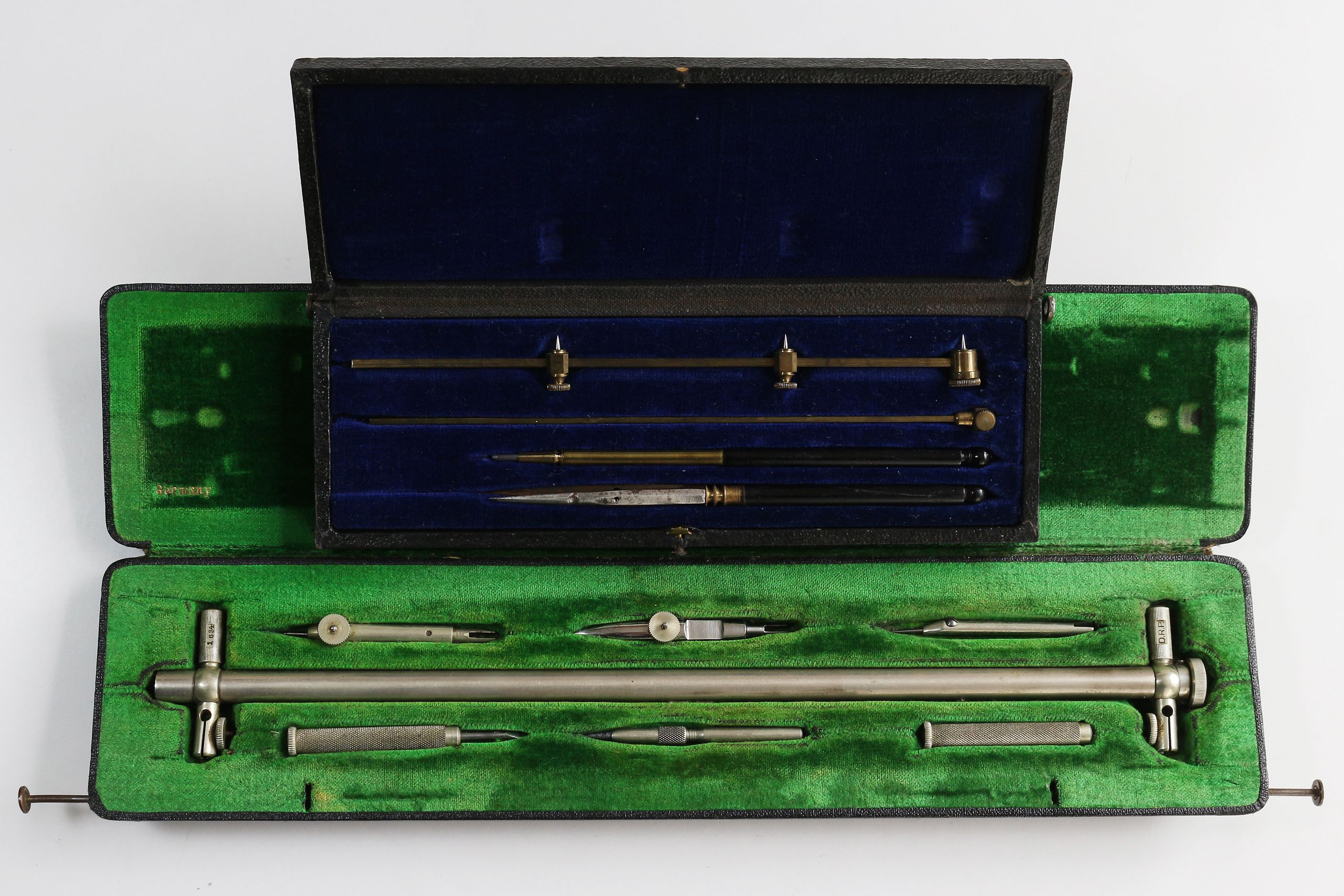
It is not unusual to come across drawing sets that lack any clue to their maker, but this recent find is also short on clues to its purpose. I have deliberately avoided calling it a beam compass because there is no obvious way to draw with it, even though it comes with a ruling pen and lead holder in the blue velvet-lined fitted case. Unlike most engineer’s trammels it has three points, only two of which are movable, the third being permanently fixed to one end of the beam. Finally, the instrument is very small in comparison to a standard beam compass or trammel, with a maximum working radius of barely 300 mm. For scale, I have photographed it next to the Hans Hass patent telescopic beam compass, which is itself on the small side as beam compasses go.
My first thought was that it might be something along the lines of Tilscher’s (much larger) perspective beam compass, which also featured three points. I haven’t yet managed to plough through Tilscher’s book System der technisch-malerischen Perspective to figure out how his compass was intended to be used, but at least one of Tischer’s trammels seems designed to accept a pen or pencil fitting. It was also supplied with a divided wooden beam (“mit durchaus in linien eingetheilter holzstange”), whereas the thin brass beam and extension of my set are plain.
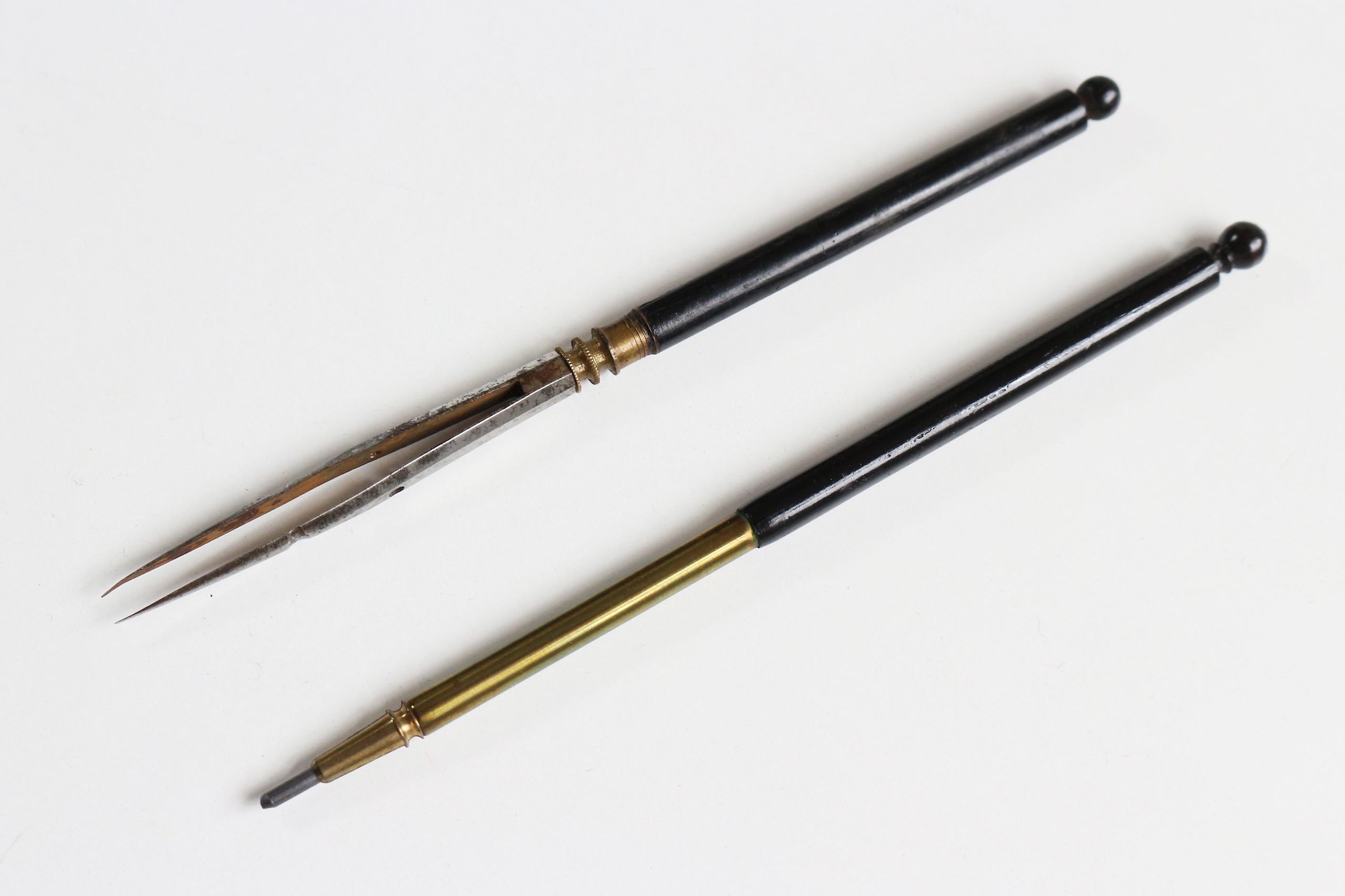
Turning to the incongruous pen and pencil in my set, closer examination reveals that both instruments have a concave portion about 20 mm above the drawing point. This would appear to be very deliberately positioned and, particularly in the case of the ruling pen, is not a feature I have seen before.
A final unusual detail is the small diameter hole through the middle of the locking nuts of both movable points and the removable nut to the fixed point. In contrast, the nut that secures the extension bar does not have a hole. This makes it seem likely that the holes are there for a specific purpose, rather than due to the manufacturing process.
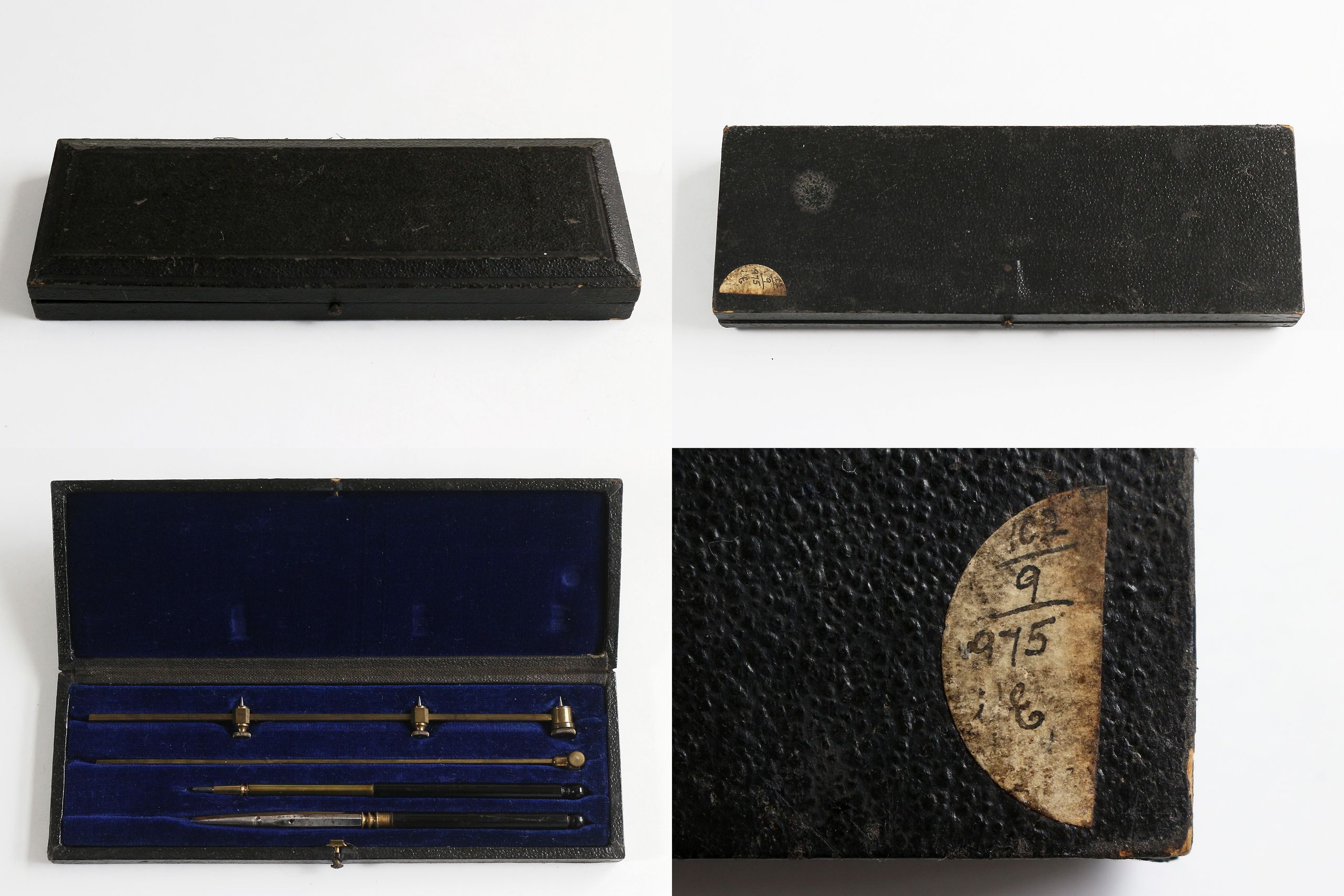
The set is brass throughout, with steel points and ruling pen blades (the pen is unfortunately missing its setting screw), while the black handles appear to be polished ebony. It is difficult to put a date to style-wise, although my initial hunch was mid to late 19th century French or Swiss. The case has a chamfered casket top (often found on earlier sets) and a rudimentary push-button closure (generally later), with a cryptic handwritten label on the underside.
One hypothesis, taking into account all of the unusual features described above, is that it might be a refinement of the simple pin-and-string method of drawing ellipses. The holes on top of the trammels could have been to accommodate standard pins, and the concave portion of the pen and pencil would have helped to keep the thread in place when drawing. In addition, the third point would have allowed symmetrical multifocal (i.e. ovoid) ellipses to be drawn, based on the principles outlined in the 1846 paper by a young James Clerk Maxwell.
Objections to this idea include the very need for such an elaborate apparatus (other than perhaps being able to precisely fix the foci for repeated curves) and the absence of a more controllable mechanism in place of the string and pins.
In theory, it is possible that with two of the points fixed to the beam and one positioned independently on the drawing surface, a hyperbola could be drawn using a string connecting one end of the pivoting beam to the independent focus (as described by Descartes in the 1630s – see this PDF René Descartes’ Curve-Drawing Devices for further detail). This would justify the need for a beam, although seems somewhat unwieldy to achieve in practice.
Several members of the Drawing Instruments group offered additional thoughts on the purpose of this instrument. Robert Pilla pointed out the similarity between the ruling pen’s long blades and those of dedicated lithography pens, used for drawing on printing stones. Along with the short, sturdy points of the trammels, this idea sounds entirely reasonable, although there is still no obvious way of using the trammel to draw on the lithography stone.
Likewise, Nathan suggested that it could conceivably work with a triangle as a very basic direct-drawing ellipsograph with the pen or pencil fitted in place of the end trammel, in much the same way as this French example. However, it does not appear that this was ever the intention, as I have tried to show with this photograph giving a detail view of the trammels with their screws removed.
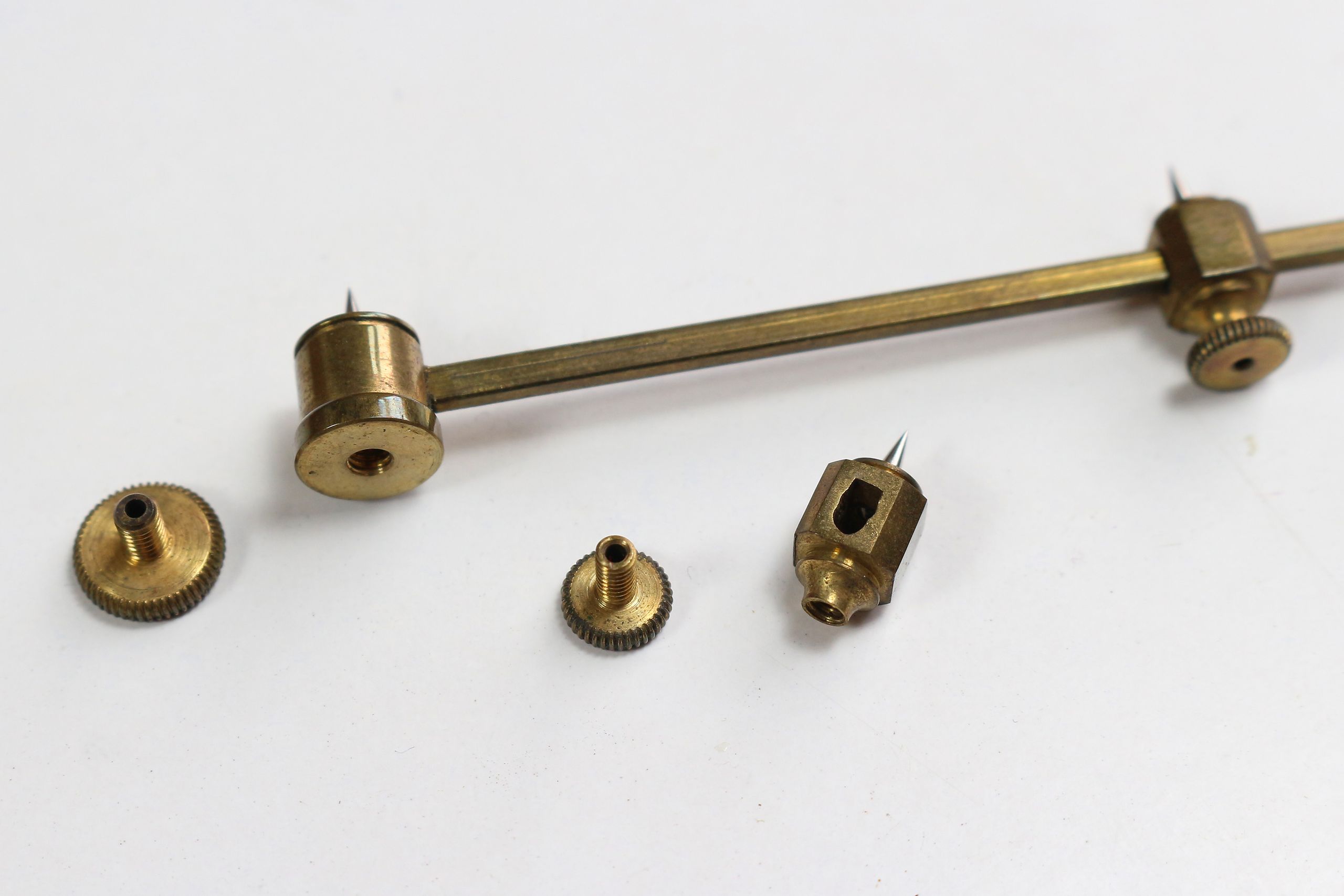
It still puzzles me why the three trammel head screws have holes through the middle, let alone why the fixed trammel would need a screw in the first place (note also that the screw for fixing the extension bar does not have a hole).
Martin White suggested another way the three points could be used to draw an ellipse, so I decided to give it a try and photograph the result. I first set out the two axes on which I marked the major and minor chords. Then the fixed head and outer moving head were directly adjusted to half the length of the major axis, followed by the fixed head and the inner moving head for the minor axis.
Once set, the outer moving head was moved incrementally along the major axis, pivoting the beam until the inner head met the minor axis line, whereupon the fixed head was pressed into the paper to mark a point on the outline of the ellipse. This was repeated for as many points as needed, before joining the prick marks using a French curve and pencil. The process was quick and ergonomically comfortable as a two-handed operation, with the larger end point being very easy to press into the paper without disturbing the position of the beam.
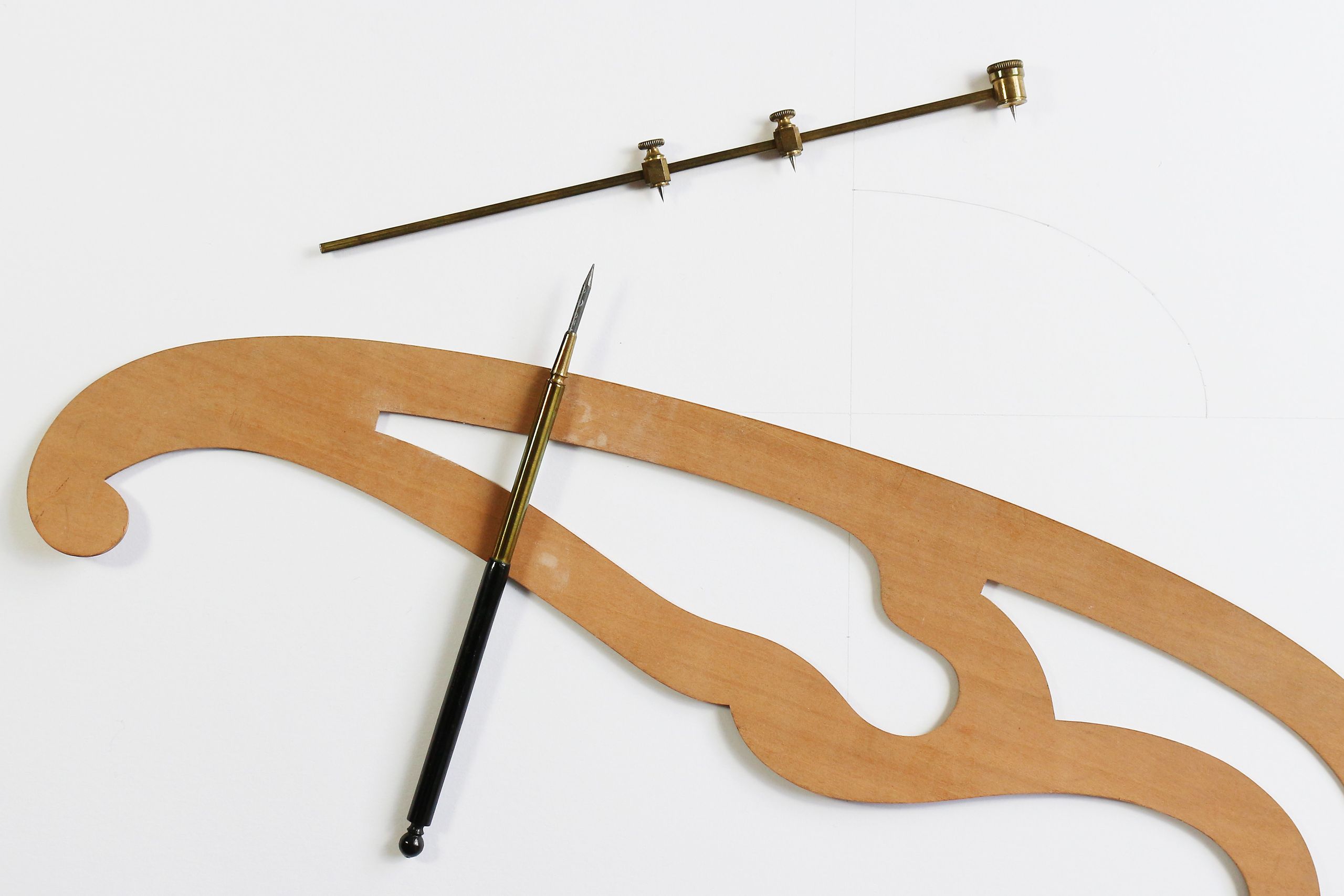
I’m still not entirely convinced that this was how the instrument was intended to be used, especially given the pierced screws mentioned above. It did however make the procedure of constructing an ellipse much more straightforward than doing the same thing by measurement, and old texts make it clear that French curves were often used to finish plotted ellipses in this way.
If anyone recognises this instrument, or is able to offer a more convincing explanation of its purpose, I would love to hear more.