
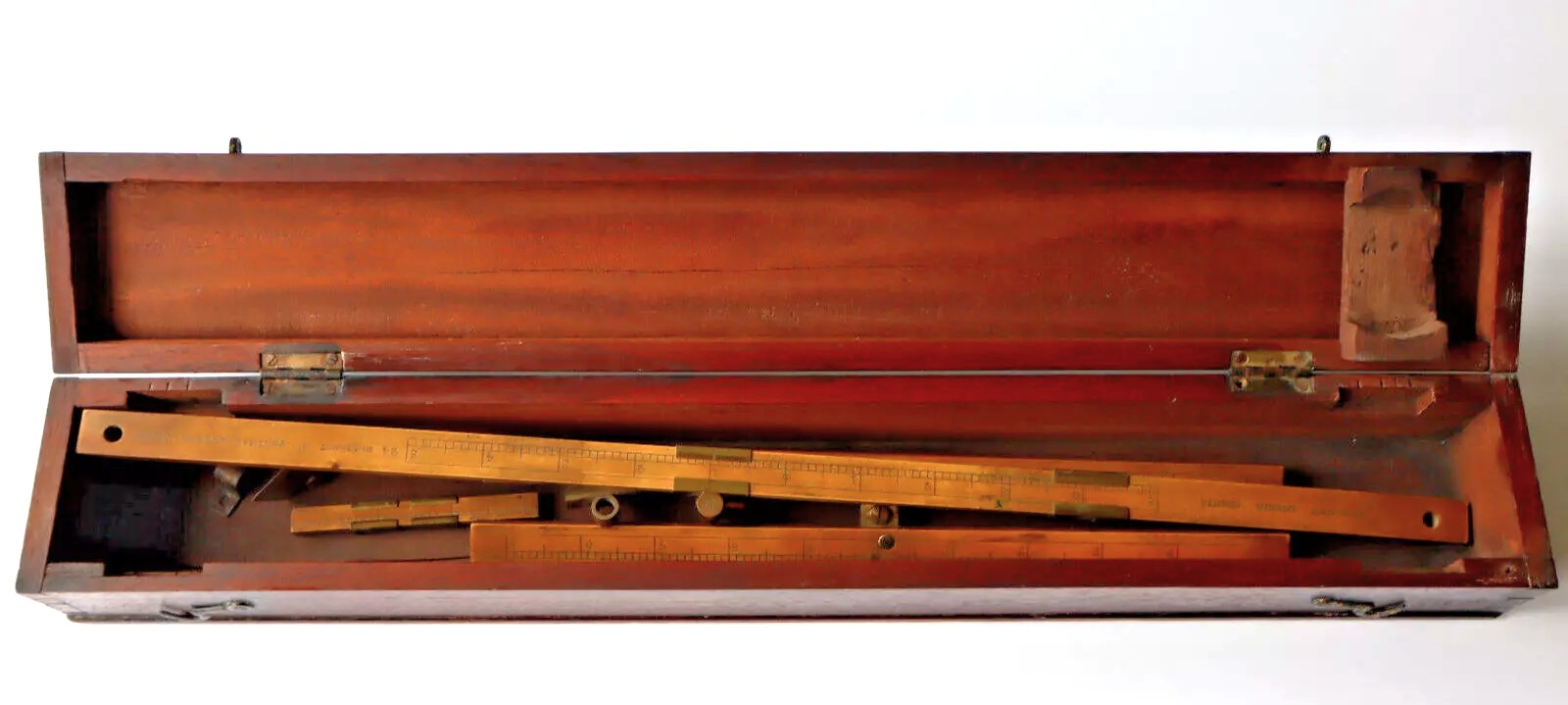
Occasionally it is worth buying something just to find out more about it, such as the box of jumbled geometric shapes that turned out to be Stanley’s version of Archimedes’ ancient Stomachion puzzle. No less puzzling was a recent auction purchase that looked for all the world like the broken remains of an old wooden pantograph, but for an odd inscription on one of the bars.

The name Jopling’s Double Cranks was not one with which I was familiar, nor does it sound particularly auspicious as a potential drawing instrument. Nevertheless, the relatively low asking price proved too much to resist, so I am now the proud owner of an old box of assorted wooden sticks.
A bit of desk-based research revealed the titular inventor to be Joseph Jopling, who seems to have been an extraordinary character – architect and civil engineer by day, but in his spare time obsessed with ancient measures (he was a major promoter of Piazzi Smyth’s bizarre pyramid expedition) and proportional systems. He also wrote an early treatise on isometric drawing (first published 1833, revised edition here), following up on the work of pioneer William Farish, circa 1822.
It turns out that the double cranks were just one part of what Jopling termed the Septenary System, an all-encompassing approach to drawing curves by continuous motion he devised while living in London in the early 1820s, his address stamped on the other end of the main bar.

Such was his faith in the universality of his discovery that, decades later, Jopling was still attempting to show that the ancient Greeks had used a similar system in the design of the Parthenon.
Clearly time has taken its toll and my double cranks are no longer complete – for a start, there is only one crank!

However, the remaining crank (the short piece at top, above) is at least identical to the missing one, so it should be relatively straightforward to fabricate a functional replacement. The rest of the woodwork appears to be present and correct, including the two jointed bars that form the drawing end of the double cranks.

Unfortunately the same cannot be said of the brass sliders and pivots, which seem to be afflicted with a serious design flaw that has resulted in a number of them shearing off (one set even appears to have been historically repaired with lead solder, but has since broken again).

Further problems await inside the original mahogany box, where the presence of four cutouts and a rather distressed block of wood with a circular recess suggest other missing parts.

Fortunately, the purpose of these can be deduced from surviving examples of Jopling’s double cranks kept at the Whipple Museum, Cambridge, and the Science Museum, London. Originally, a pair of these wooden blocks would have been used to retain two brass weights that provided the stable base upon which the main bar was supported.
The missing weights look quite hefty, with some kind of separate brass base and column structure around which the weight itself sits. I may need to pay a visit to one or other of the aforementioned museums in order to establish their exact size and configuration.
Clearly it would take some effort to restore the double cranks to working order, but doing so would potentially be of great interest as an exercise in experimental archaeology, not least to establish why some of the parts have failed so catastrophically. Stay tuned for updates!


