Don’t worry, this isn’t another of those spam emails advertising protein shakes or the like. I’m talking weights. Ship weights. Admiralty pattern.
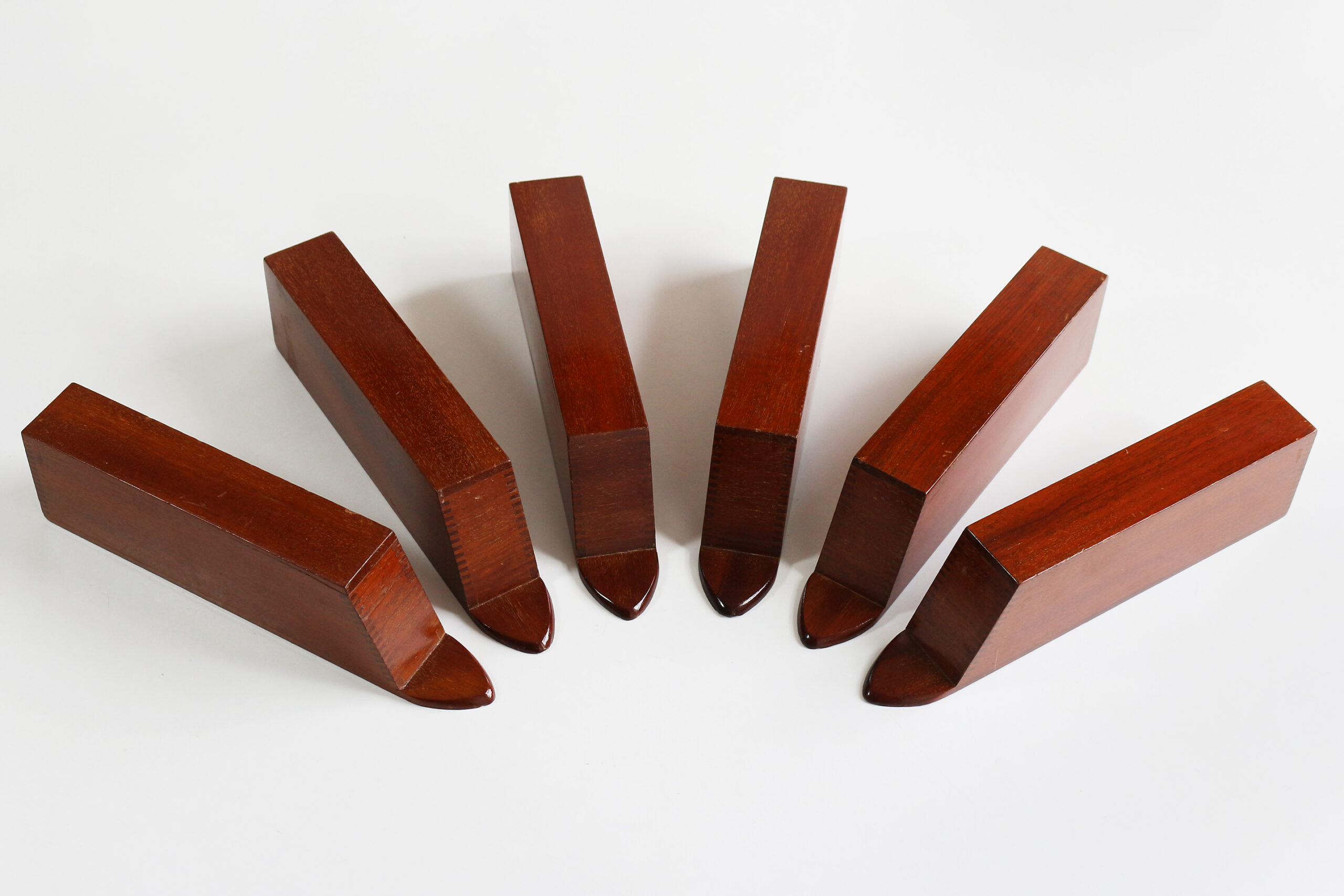
These were the extremely heavy lead blocks (variously known as ducks, whales, dogs, rats and newts) the purpose of which was to accurately locate long, flexible strips of wood called splines used for “lofting” (remember lofting pencils?), or the drawing of full-size curves, particularly in naval architecture and later in aircraft design. For obvious reasons they are now rather difficult to come by, having been not only a very niche piece of equipment, but also exceptionally unwieldy to move and store.
The set of six I purchased survived by being repurposed as bookbinding weights in the 20th century, and thankfully it remains in beautifully looked after condition (which is just as well, given that it weighs more than 11 kg, or approximately 25 pounds). It is identical in design and size to a signed Stanley set that sold at auction a few years ago, and for various reasons I expect my set was also made in Stanley’s joinery shop.

Ship weights do not seem to have been particularly widely available even in the 19th century, appearing in few manufacturers’ catalogues of the time. They are not offered in lists I have by Elliott or Negretti & Zambra, and although lancewood splines were sold by Casella in 1871, the accompanying weights were absent.
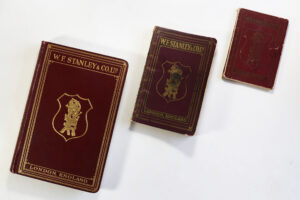
They are, however, included in Stanley’s catalogues from the very earliest ones right through to the 1960 edition, which even gives the option of splines in transparent plastic (I have uploaded a summary of entries from 1865 to 1888 in the Curves album). The earliest design, predating the Admiralty pattern, is illustrated in the 1868 edition of Mathematical Drawing Instruments where the author gives the following description:
“WEIGHTS AND SPLINES, or Penning Battens, as they are sometimes called, are used to form figures of irregular large curvature, which they delineate more gracefully than the curves already described: they are used principally by ship architects. The set of weights and splines generally consists of six weights, and five or more splines. The weights are generally made of lead, and neatly covered with mahogany, or of thin castings of brass, loaded with lead; they have one end brought out in the form of a wedge, the thin edge standing up vertically upon the drawing. The splines are thin, tapering pieces of lancewood or red pine, from eighteen inches to eight feet long, and from three-eights to one eighth of an inch square at the largest end, diminishing off to the smaller in varying proportions.”
The illustration shows the loaded brass casting design, from which it is evident where the term “ducks” originated. As is often the case, this is the pattern that remained in use across the Atlantic, having been widely adopted before later developments superseded it in the UK. It was also the only type listed in Stanley’s 1865 catalogue, where a set of six weights and six lancewood splines would have set you back two pounds and fifteen shillings (almost £400 today).

By the 1868 price list these have been joined by the “Admiralty pattern” weights at £2 16s., while the old-style ducks are discounted to £2 5s. The illustration in the next edition of Stanley’s book (1873) is correspondingly updated to show the new Admiralty weights, and the price list at the rear shows a discount of 6s. while the old weights remain the same price as before. The reference to brass castings in the text was also removed from this and all subsequent editions of the book. By the 1888 catalogue, the old pattern was no longer sold, and although the cost of the Admiralty weights remained the same, the lancewood splines were now supplied seperately at 14 shillings for a case of a dozen.
The 1873 drop in the price of the mahogany-cased weights may have been the result of mechanisation, as around this time Stanley opened his new South Norwood works, where the joinery department was equipped with modern machine tools that could produce comb-jointed cases at a fraction of the cost of the old labour-intensive dovetailing. As can be seen from the photos, the corners of the mahogany casing to the lead weights are very delicately comb jointed, as is the sturdy box they came in, allowing this set to be dated to the mid-1870s or later. Both the lack of an escutcheon to the keyhole and the lock mechanism itself are in keeping with Stanley’s earlier non-drawing instrument boxes, so my feeling is that the set may date to this transitional period of the late 1870s.
An interesting detail that I was previously unaware of is the slight notch cut beneath the projecting lip of each weight, allowing it to be better located on the edge of the spline. With each weight coming in at 1.6 kg, or three pounds and nine ounces, I imagine they would have had no trouble keeping even the most tensioned spline securely pinned down.

The development of ship weights did not stop there. By Stanley’s 1919 catalogue, the Admiralty pattern had been joined by “Stanley’s new pattern”, closer in appearance to the earlier “ducks”, but now with a mahogany base. In 1910, ER Watts sold a different design again, described as “covered imitation leather, with finger”, in three sizes of 8 lbs., 3 lbs. and 1.5 lbs. They were more widely available in the US, sold by most major suppliers, usually with a projecting steel hook (the same as Watts’ “finger”?) to hold the spline.
As a concept, splines survived long enough to become an established part of computer aided design where, in spite of the complex mathematics behind them, they behave in much the same way as the old weights and battens, with curves being defined by adjustable points each with their own “tension” setting. Even so, the internet suggests that there are still plenty of people using traditional splines and weights today, and even selling new ones (now in bronze, not lead).